I-2533CS-FD-UL series
CAN/CAN FD to Single-mode Fiber Bridge


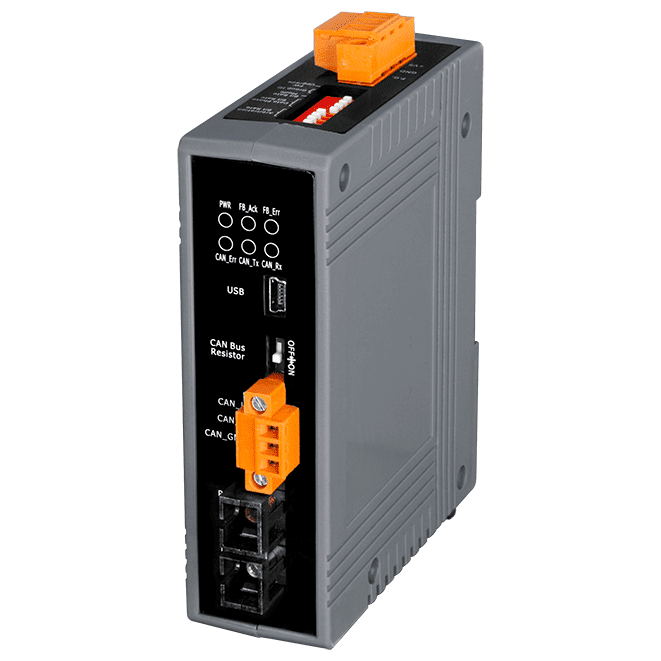
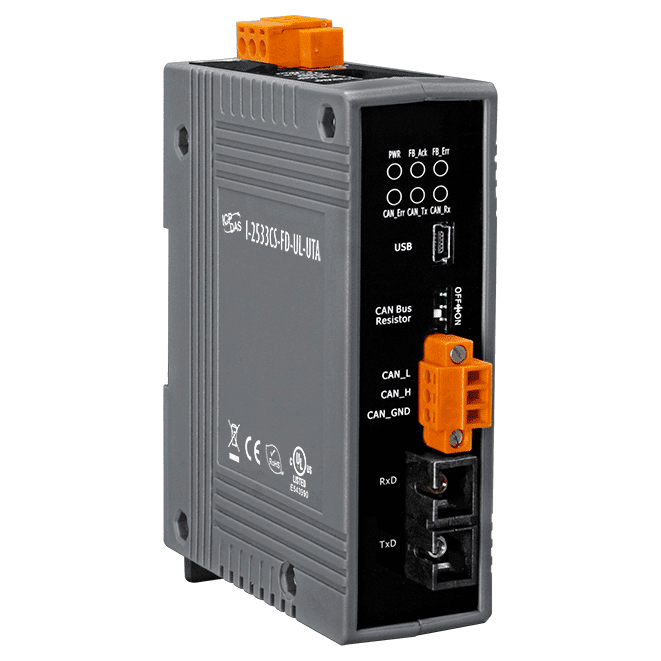
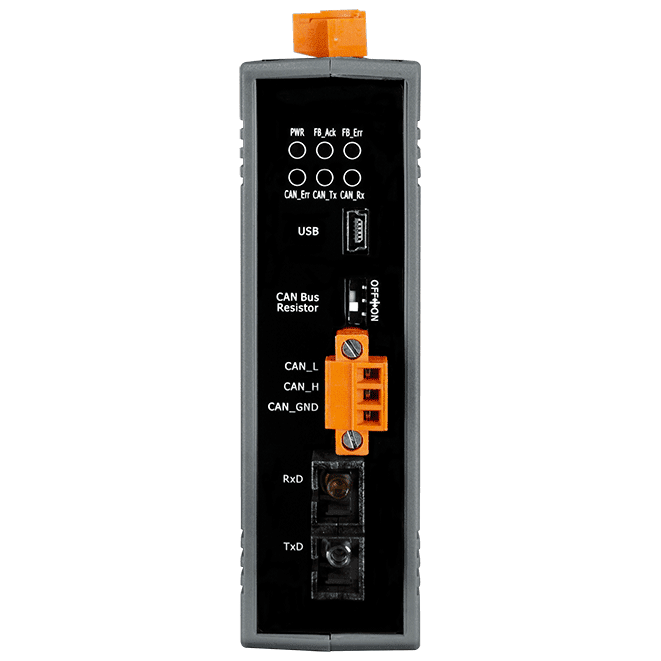
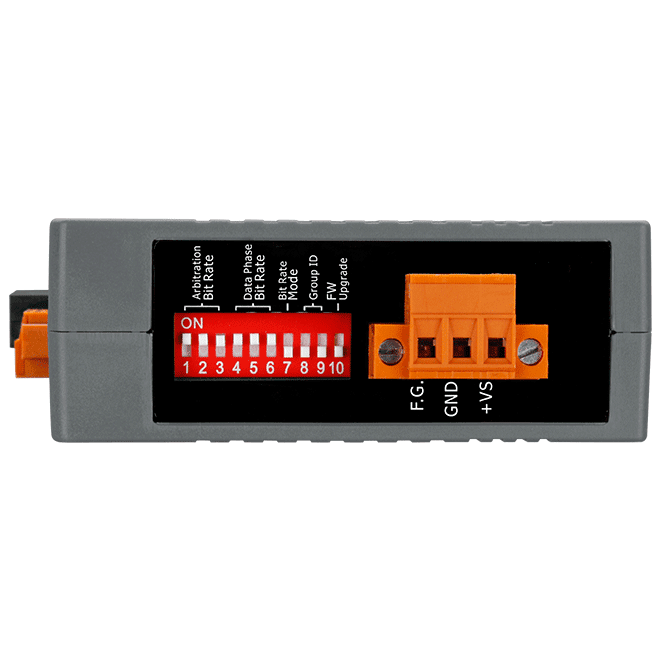
Features
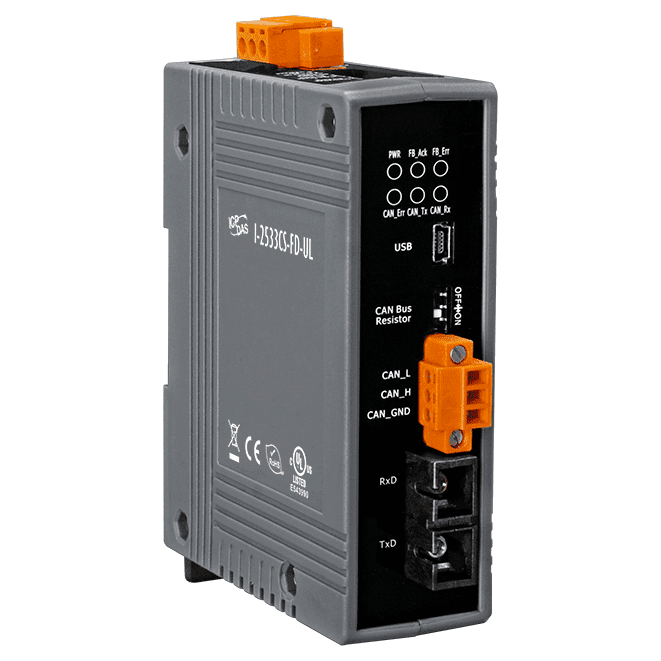
- Compatible with the ISO 11898-2 standard
- Compatible with CAN specification 2.0 A/B and FD
- CAN FD support for ISO and Non-ISO (Bosch) standards switchable
- CAN FD bit rates for data field from 100 kbps to 10000 kbps
- CAN bit rates from 10 kbps to 1000 kbps
- Fiber broken line detection
- Support CAN Bus message filter configuration
- Support firmware update via USB
- Basic CAN message routing function via Group ID settings.
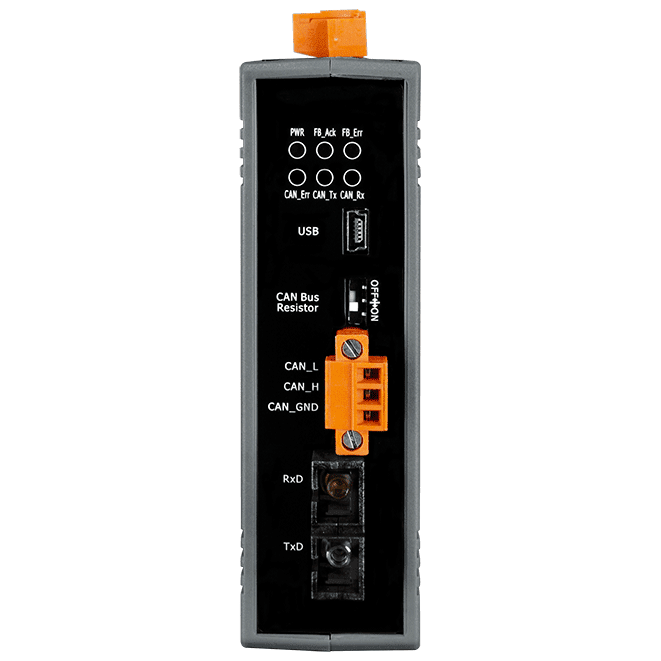
- Built-in switchable 120 ohm terminal resistor for CAN Bus
- Dip switch for CAN/CAN FD baud rate configuration


Introduction
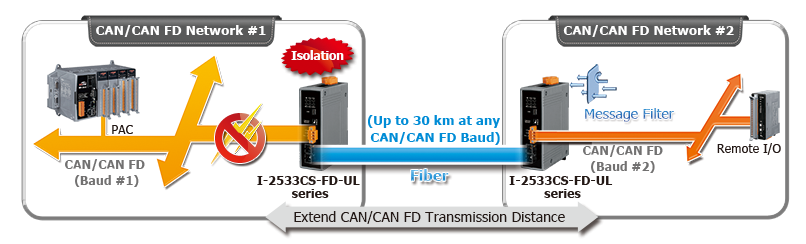
The I-2533CS-FD-UL series is a local CAN/CAN FD (CAN with Flexible Data-Rate) bridge used to establish a connection between two CAN bus system via single mode fiber optic transmission medium. In order to solve the problem between CAN/CAN FD and fiber transmission medium, theI-2533CS-FD-UL series is specially designed for converting the electrical CAN/CAN FD bus signal to fiber optic cables. Besides, I-2533CS-FD-UL series has three more important features. First, the transmission distance limitation of the CAN bus system will not affected due to the different CAN/CAN FD baud rate. It means that the total CAN/CAN FD bus working distance can be extended. Second, the bus error on one CAN/CAN FD network will not affect the operation of another CAN/CAN FD network. Finally, the two CAN/CAN FD network can communication with each other by using different CAN/CAN FD baud rate for highly flexibility.
The I-2533CS-FD-UL series modules have obtained UL certification, meeting strict safety standards including fire resistance, electric shock protection, and durability requirements. This ensures stability and safety across various usage environments, providing consumers with reliable quality assurance. The UTA version uses conformal coating technology that offers excellent resistance to moisture and salt spray, making it particularly suitable for coastal and high-humidity environments.
Applications

Ordering Information
| PRODUCT SERIES | DESCRIPTION | QNT. | INQUIRY |
|---|---|---|---|
Similar Products
| LED Indicators | |
|---|---|
| Status | 1 x Power, 3 x CAN status, 2 x Fiber status |
| Fiber | |
|---|---|
| Fiber Cable | 8.3/125, 8.7/125, 9/125 or 10/125 μm |
| Wavelength | 1310 nm |
| TX Output | -15 dBm Min. , -8 dBm Max. |
| Transmission Distance | 30 km (9/125 μm recommended) |
| RX Sensitivity | -34 dBm Max. |
| RX Overload | -5 dBm Max. |
| Budget | 19 dBm |
| Propagation Delay | 190 us (*Note1) |
| USB | |
|---|---|
| Specification | USB 2.0 High Speed (480Mbps) |
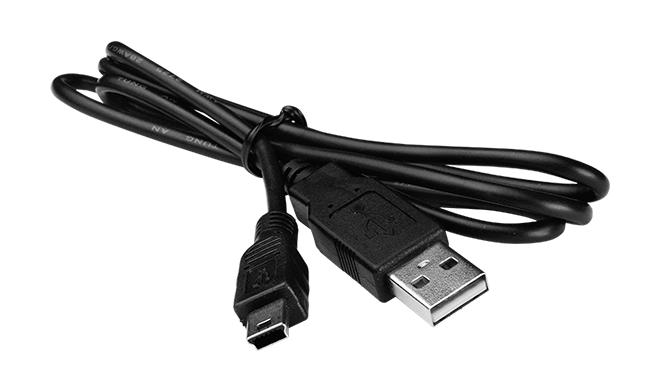
| Connector | USB Type B, Mini-B |
| Driver | Built-in Windows 7/8.1/10 |
| CAN | |
|---|---|
| Ports | 1 |
| Specification | ISO 11898-2, CAN 2.0 A/B and FD |
| Baud Rate | CAN bit rates: 10 k ~ 1 M bps, CAN FD bit rates for data field: 100 k ~ 10M bps (*Note2) |
| Terminal Resistor | Switch for 120Ω terminal resistor |
| Filter | Yes |
| Power | |
|---|---|
| Input Range | +10 VDC ~ +30 VDC |
| Consumption | 3 W |
| Mechanical | |
|---|---|
| Casing | Plastic |
| Dimensions (mm) | 33 x 127 x 101 (W x L x H) |
| Installation | DIN-Rail |
| Environment | |
|---|---|
| Operating Temperature | I-2533CS-FD-UL: -25 ~ 70 ℃ I-2533CS-FD-UL-UTA: -40 ~ 70 ℃ |
| Storage Temperature | -30 ~ +80 °C |
| Humidity | 10 ~ 90% RH, Non-condensing |
Specification Memo
Note2: The maximum CAN FD data rate can be exceeded depending on the concrete operating conditions (cable length, network topology, settings,...), but it can also not be reached.