
Data Transmission Mode
Data Transfer Methods
Ethernet acquisition modules convert external analog signals to digital signals using different sampling methods. These digital data are first temporarily stored in the module's memory and then transmitted to the PC host via TCP using different data transfer methods.
Two Methods:
1. Command Response Mode
The command response mode is a common communication method used by acquisition modules. When the host sends a command to the module, the module starts collecting data and then transmits the data back to the host. In another method, such as protocols like Modbus/TCP, the firmware of the acquisition module collects data at a fixed sampling rate and temporarily stores it in the module's memory (e.g., Modbus Register table). When the host sends a command to the module, the module transmits the relevant buffered data back to the host as needed.
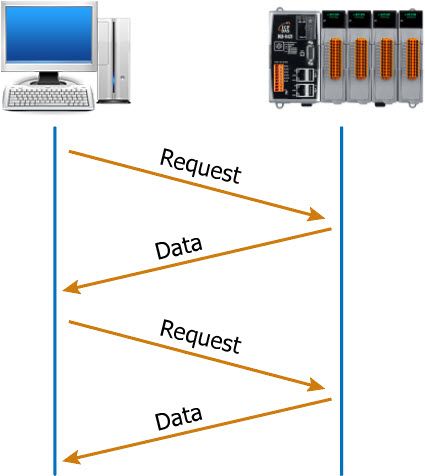 |
| Figure 1: Command Response Communication Mode diagram |
In this mode, data transfer is controlled by the host PC software. Since most host PCs have varying hardware processing speeds and their operating systems (Windows, Linux) are multitasking, non-real-time systems, the timing of sending commands can be unstable due to different software and the number of executing tasks. Additionally, the Ethernet network speed or network topology can affect the stability of the command send timing. When the communication speed and sampling speed differ, the host's query commands might repeatedly read buffered data or miss the current data, leading to discontinuous data acquisition.
Using this method results in unstable acquisition times and cannot meet the needs for high sampling rates and large data volume acquisition.
The timing diagram for the command response communication mode (Figure 2) shows that the host's query times t1~t5 are not the same. At points A and B, it is evident that the read data differs from the input signal data.
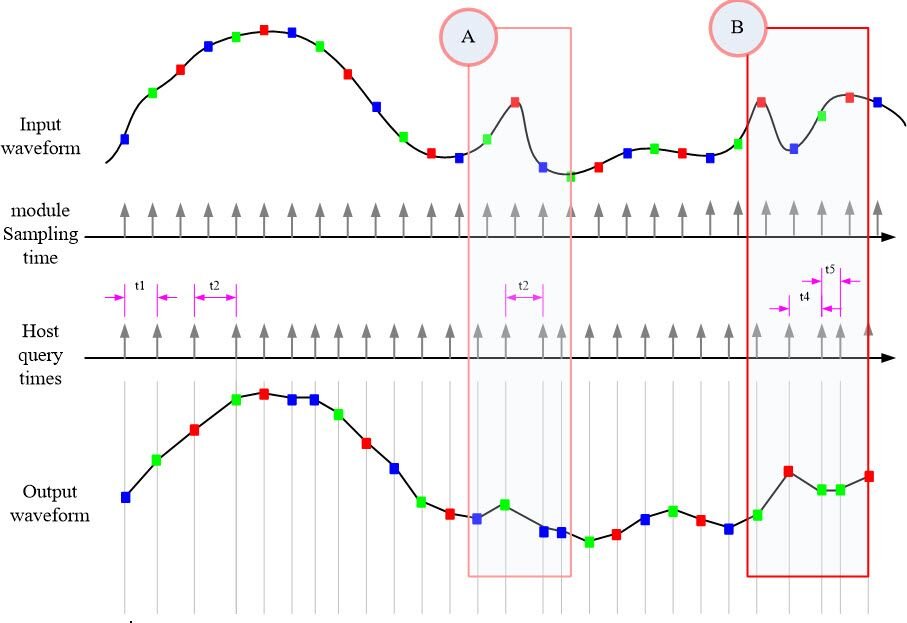 |
| Figure 2: Command Response Communication Mode Timing Diagram |
2. Streaming Mode
Streaming mode is suitable for high-throughput data transmission. It enables very fast data acquisition rates, but to maintain this speed, data must be buffered and transferred in large packets from the device to the host.
In the streaming approach used by ICPDAS modules, most adopt synchronous or interval scanning sampling. These methods allow for setting different data sampling rates (scan rate specifies the interval between each scan start). Data is collected automatically by hardware/firmware according to the sampling rate and placed in module buffers. When a sufficient amount of data is accumulated, it is actively sent to the host. With polled scanning sampling, the data sampling rate is fixed, and firmware polling scans place data in the module buffer, which is then sent to the host when a certain amount is accumulated.
When the host sends a start acquisition command, the module uses the above methods to transmit data in large packets to the host until the host sends a stop acquisition command to halt data collection. Unlike the command-response mode that involves back-and-forth communication, streaming mode eliminates most communication packet exchanges and query command processing time, thereby enhancing communication efficiency. It is well-suited for applications requiring high sampling rates and large data volume acquisition.
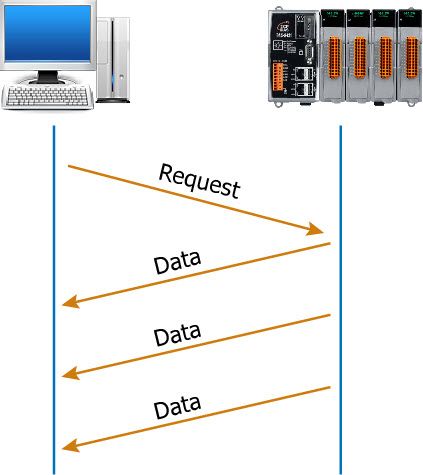 |
| Figure 3: Streaming Communication Mode Diagram |
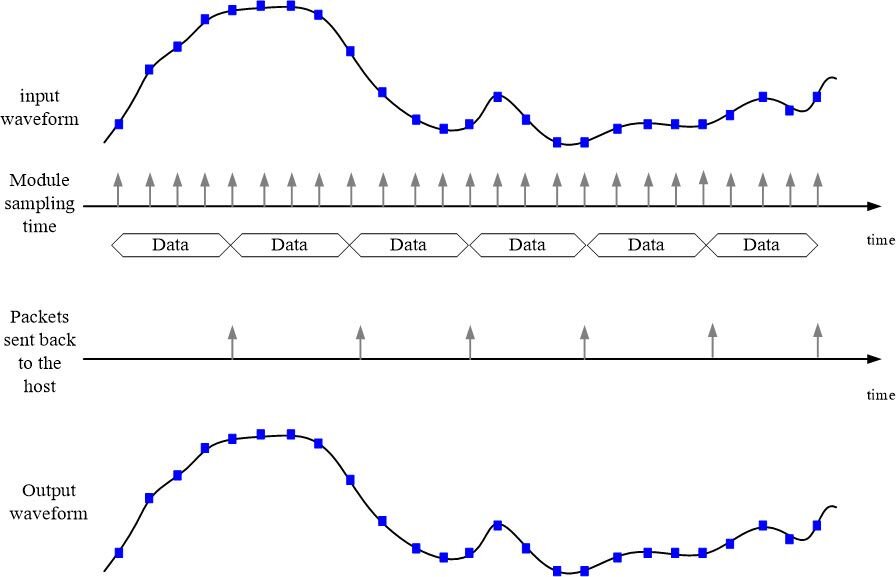 |
| Figure 4: Streaming Communication Mode Timing Diagram |